
Process Intensification of Biologics: A Practical Introduction
Overview
Process intensification (PI) is reshaping how biologics are manufactured, offering higher productivity, smaller facility footprints, and greater operational flexibility compared with conventional fed-batch processing. This one-day onsite course provides a practical introduction to PI for biologics drug substance manufacture — beginning with the fundamentals of conventional manufacturing, then building through the drivers and science behind intensification, the operational and control strategy implications, and the regulatory landscape (ICH Q13).
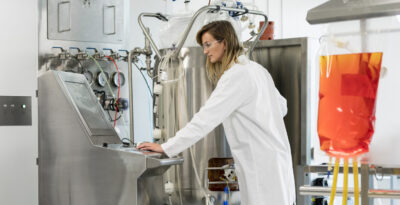
The day alternates between classroom sessions and time in NIBRT’s manufacturing facilities. An initial facility session lets participants see conventional and intensified technologies side by side and understand how day-to-day operations differ — from campaign duration and solution preparation demand through to changeover and staffing. A second, longer practical session provides hands-on experience with some of the latest intensification technologies, including single-use stirred tank reactor and alternating tangential flow (ATF) perfusion set-up, single-use connection and welding operations, and continuous filtration flow path installation, alongside guided discussion of technologies such as continuous chromatography.
The course is designed to build working knowledge and practical familiarity rather than to deliver full operational competency in any single technology.
Key topics covered
- Explain the commercial, operational, and scientific drivers behind the adoption of process intensification, and the scientific basis on which intensified processing depends.
- Identify key upstream and downstream intensification technologies and describe their function within a continuous process.
- Compare conventional and intensified manufacturing in terms of facility footprint, campaign duration, solution preparation demand, changeover, and staffing implications.
- Describe control strategy requirements for intensified and continuous processes, including batch definition, traceability, and the role of automation and digitalisation.
- Outline the scope and key expectations of ICH Q13 and associated regulatory considerations for implementing PI in a GMP environment.
- Carry out selected set-up and operational tasks for intensified upstream and downstream technologies under supervision.
Who should attend
This course suits those who want both a conceptual grounding in process intensification and practical exposure to the technologies involved. It is appropriate for:
- Manufacturing, process development, and MSAT personnel moving toward, or evaluating, intensified processes
- Operators and technicians who will work with intensified upstream or downstream equipment
- Quality, regulatory affairs, and compliance professionals who need to understand control strategy, batch definition, and ICH Q13 implications
- Engineers and technical staff involved in facility design or technology assessment
- Managers and decision-makers building the case for PI adoption
The course begins with the fundamentals of conventional biologics manufacturing, so no prior experience of intensified or continuous processing is required. While some prior knowledge of biopharmaceutical manufacturing operations is expected, participants with limited biomanufacturing background will be brought up to speed during the opening lecture, while those already familiar with conventional operations will find the emphasis falls on what changes with adoption of intensification.
Register
Course Format
Full course onsite at NIBRT
- 1 full day onsite training at NIBRT facility
Dates & Price
Dates:
- Course 1 15/12/2026€995.00
8 Places Remaining